





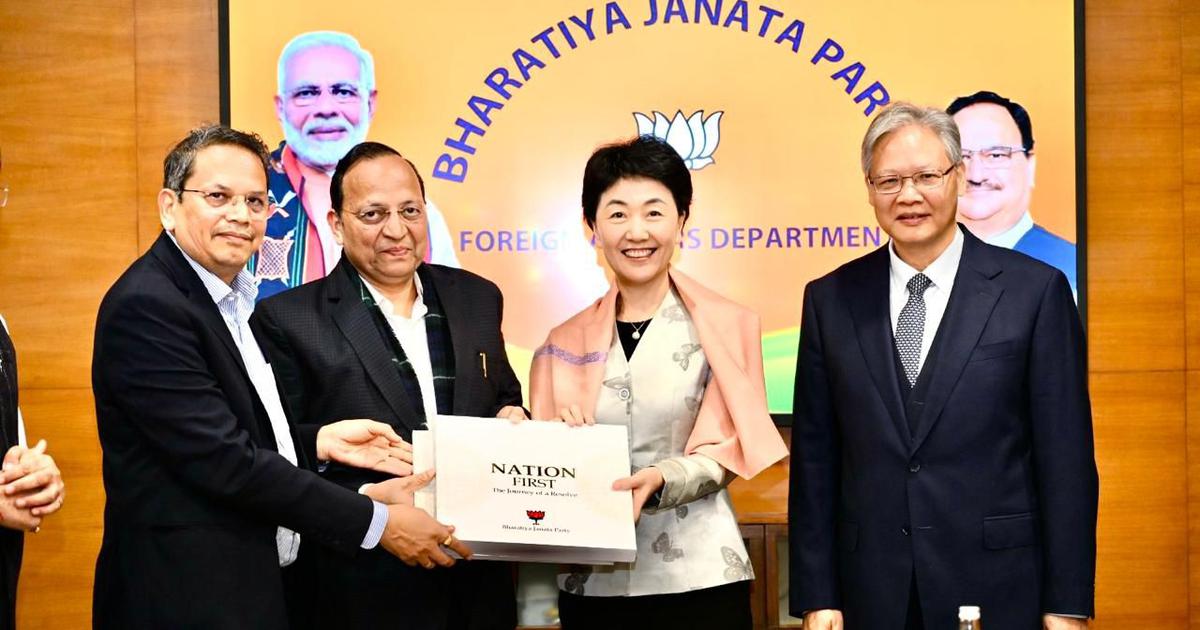
A delegation of the Communist Party of China this week met office-bearers of the Bharatiya Janata Party and its parent organisation, the Rashtriya Swayamsevak Sangh, in Delhi. This was the first interaction between the two entities since the Galwan clashes in 2020.
The BJP said that they discussed how to enhance communication with China’s ruling party.
Monday’s meeting came at a time when the Chinese government has been reiterating its territorial claims on the Shaksgam Valley. New Delhi says that the region is Indian territory and historically a part of Jammu and Kashmir. Pakistan ceded it to China in 1963 in an agreement not recognised by India.
While New Delhi has repeatedly objected to infrastructure projects undertaken by Beijing there, the Chinese foreign ministry on Monday said that the programmes were “beyond reproach”.
While the BJP-RSS and the Chinese Communist Party have maintained contacts since at least the late 2000s, the contrasting rhetoric from New Delhi and Beijing perhaps illustrates the knotty China problem the BJP is facing.
A tangled relationship
There was a time not too long ago when the BJP repeatedly accused Congress of signing a “secret” Memorandum of Understanding with the Chinese Communist Party in 2008. It also alleged that Congress leader Rahul Gandhi had met with Chinese officials during the 2017 Doklam standoff between India and China.
The Congress rejected the allegations and the events this week gave it the political ammunition to clap back at the BJP. It reminded the Hindutva party that China had supported Pakistan during Operation Sindoor in May.
The Indian military has publicly described China as one of its adversaries during the four-day conflict, saying that Pakistan was receiving real-time intelligence from the Chinese military about important Indian deployments.
The Congress also reminded the BJP that Indian soldiers had been killed in Galwan and that the Chinese People’s Liberation Army was “sitting there after encroaching in Ladakh”.
“[China] is settling villages in Arunachal Pradesh,” Congress leader Supriya Shrinate added. “And here, hugs are being exchanged.”
Border tensions between India and China escalated in June 2020 when a violent face-off between Indian and Chinese soldiers took place in Ladakh’s Galwan valley along the Line of Actual Control. It led to the deaths of 20 Indian soldiers. Both countries had deployed thousands of soldiers and heavy artillery in the region, creating a prolonged stand-off.
In October 2024, a patrolling arrangement, “leading to the disengagement” of the two militaries in eastern Ladakh, was announced. But it is unclear whether the status quo ante, or the situation before the clashes, has been restored.
Broader concerns remain about Beijing’s growing sway in South Asia, a region India considers its sphere of influence.
A rapprochement
There is a crucial reason why India’s BJP-led government is turning a blind eye to these impediments.
With United States President Donald Trump’s transactional approach to foreign policy, so-called reciprocal tariffs, punitive levies and repeated claims of having mediated a ceasefire between India and Pakistan having all but sunk the burgeoning India-US partnership, New Delhi has had to hasten to recalibrate its relationship with Beijing.
However, as we noted in an earlier edition of Slow Lane, Trump’s actions are viewed as an accelerant of and not the catalyst for the India-China rapprochement.
Over the past half year, there have been several high-level bilateral engagements between India and China. This has proceeded along with measures such as resuming direct flights between the two countries, restarting the Kailash Mansarovar Yatra and reopening visa services.
The Chinese foreign minister said in December that New Delhi and Beijing had picked up “good momentum”, citing Prime Minister Narendra Modi’s visit to Tianjin in August for a multilateral summit.
India seems eager to take a bigger step in economic cooperation. Reuters reported on January 9 that in view of “reduced border tensions”, the Union government is planning to scrap restrictions introduced after the Galwan crisis that required Chinese firms seeking Indian government contracts to register with a committee, and secure political and security clearances.
The push by both India and China to rebalance their relationship despite the challenges has been so striking that even the US has taken note of this changed mood.
Here is a summary of last week’s top stories.
Maharashtra politics. The Bharatiya Janata Party and its allies won most of the 29 municipal corporation elections in Maharashtra on Friday, a day after polling took place.
In Mumbai, the country’s richest civic body, the BJP and Deputy Chief Minister Eknath Shinde’s Shiv Sena faction 118 seats of the 227 in the Brihanmumbai Municipal Corporation.
The victory margin was slimmer than predicted by exit polls. The Opposition alliance mainly comprising the Uddhav Thackeray-led Shiv Sena group and Raj Thackeray’s Maharashtra Navnirman Sena won 72.
The BJP also won in Nagpur, Nashik and Navi Mumbai, and defeated the alliance of the two Nationalist Congress Party factions in their Pune and Pimpri-Chinchwad strongholds. The Shinde Sena won in Thane and Kalyan-Dombivali.
The state’s six major political parties had contested the polls in varying combinations of tie-ups in different cities. In several cities, the civic polls took place after a four-year delay.
Bloodshed in Iran. About 2,000 persons, including security personnel, have been killed during the anti-government protests in Iran, an official told Reuters on Wednesday.
India issued a fresh travel advisory urging its citizens to avoid travelling to Iran. The country’s embassy in Tehran also asked Indian citizens in Iran to leave at the earliest. There are about 10,000 Indians in Iran, including a large number of students.
The protests, which began on December 28, initially focused on discontent about rising inflation. However, they later expanded in scope as protesters in more than 100 towns demanded an end to clerical rule. On January 8, the government snapped internet access and telephone lines, largely cutting off the country from the outside world. The authorities in Iran have accused the United States and Israel of inciting the unrest.
What led to Zubeen Garg’s death? The Assamese singer was “severely intoxicated” and not wearing a life jacket when he drowned during a yacht trip in September, the Singapore Police told a coroner’s court. Assistant Superintendent of Police David Lim said Garg had refused to wear a life vest despite repeated reminders and swam away from the yacht before becoming motionless and floating face down.
Garg died in September during a yacht trip in Singapore, a day before he was scheduled to perform at the North East India Festival there.
He was pulled back on board and given cardiopulmonary resuscitation before being taken to hospital, where he was pronounced dead. An autopsy found 333 mg of alcohol per 100 ml of blood in his system. The police said there was no evidence of suicide, duress or coercion.
Also on Scroll last week
- Assam’s nowhere people: 24 hours to leave India, tossed back and forth across Bangladesh border
- Are blanket bans on VPN use in India legal?
- Single mother, BJP MLA, Marwari trader: The Bengal voters on EC’s SIR radar
- Why Haryana wants cameras in hospitals before settling insurance claims
- How sugarcane farming fuelled a rise in leopard attacks in Maharashtra
- Why hundreds of H-1B visa holders are stuck in India after the winter break
- Across South Asia, leaders are promoting hate to distract citizens from economic insecurity
- Why Indian laws fail to protect women online
- Shakti Samanta centenary: ‘There wasn’t a moment when he wasn’t thinking of films’
- ‘Happy Patel: Khatarnak Jasoos’ review: In scattershot comedy, anything goes and little lands
Follow the Scroll channel on WhatsApp for a curated selection of the news that matters throughout the day, and a round-up of major developments in India and around the world every evening. What you won’t get: spam.
And, if you haven’t already, sign up for our Daily Brief newsletter.
